

Official 2027 tariff sheets: Groupe E · Romande Energie · BKW · SIG · Oiken · SIL · Viteos · Gruyère Energie · SEFA · SIE
Distribution system operators (DSOs) have published their 2027 tariff sheets. For industrial sites and large consumers, who pay a power component on top of energy, the differences are large, and they move in opposite directions depending on the DSO and the voltage level. We compared the 2027 sheets of ten French-speaking Swiss DSOs with 2026: Groupe E, Romande Energie, BKW, SIG, Oiken, SIL, Viteos, Gruyère Energie, SEFA and SIE.
Two components to read together
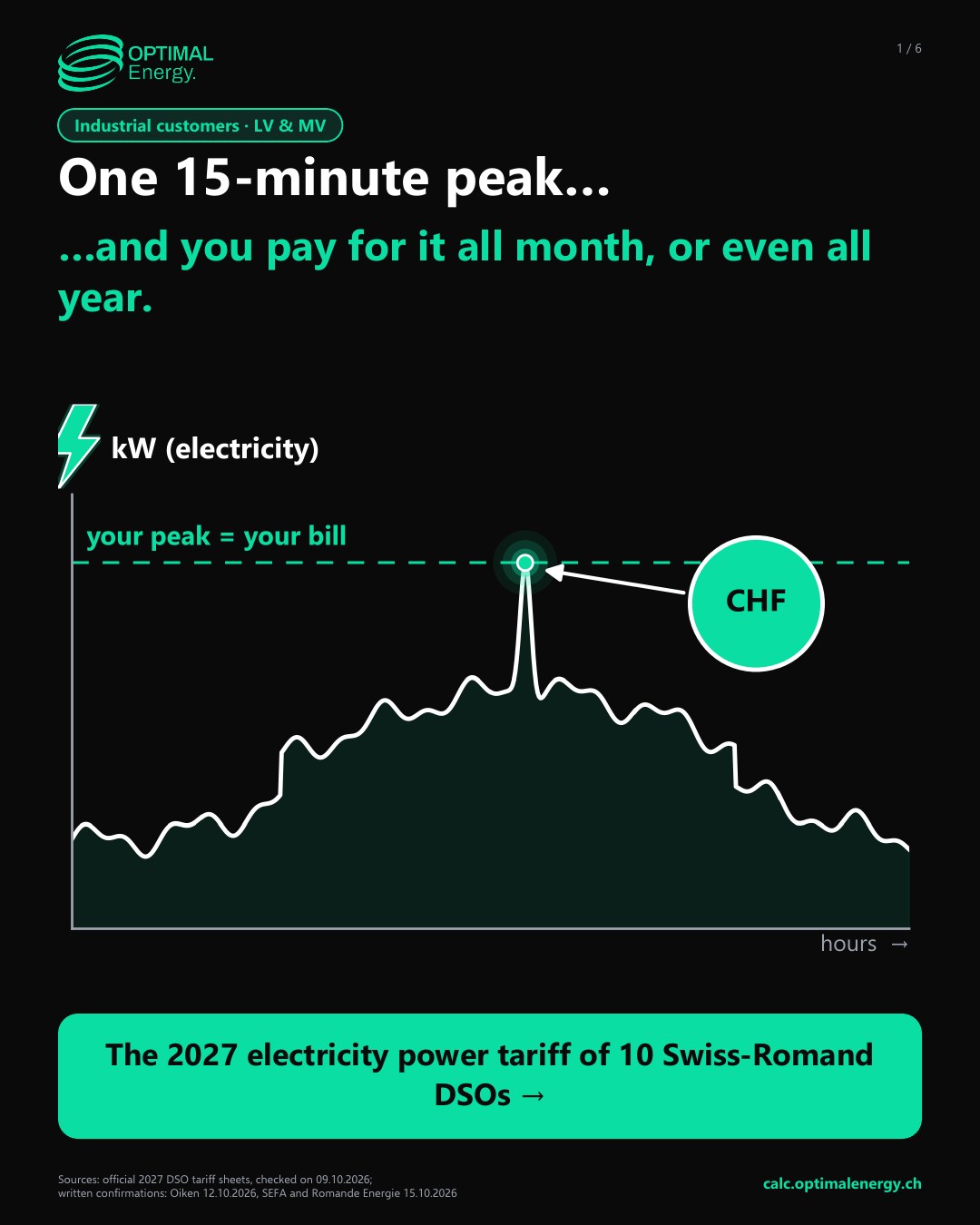
A large consumer’s network bill usually combines a power component, in CHF per kW per month, applied to the highest 15-minute peak of the billing period, and an energy component, in cents per kWh. A battery that shaves peaks acts on the power component.
What changes in 2027
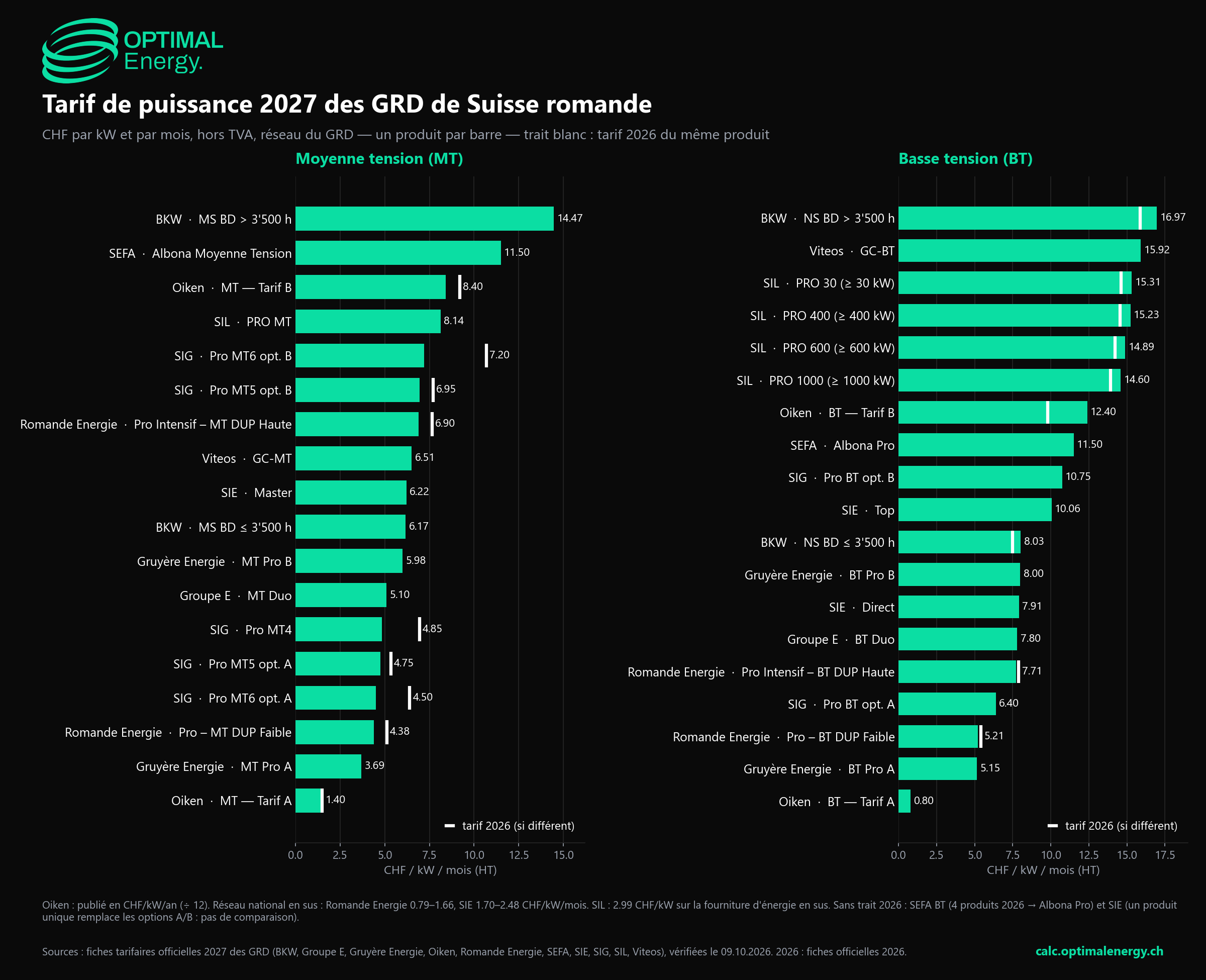
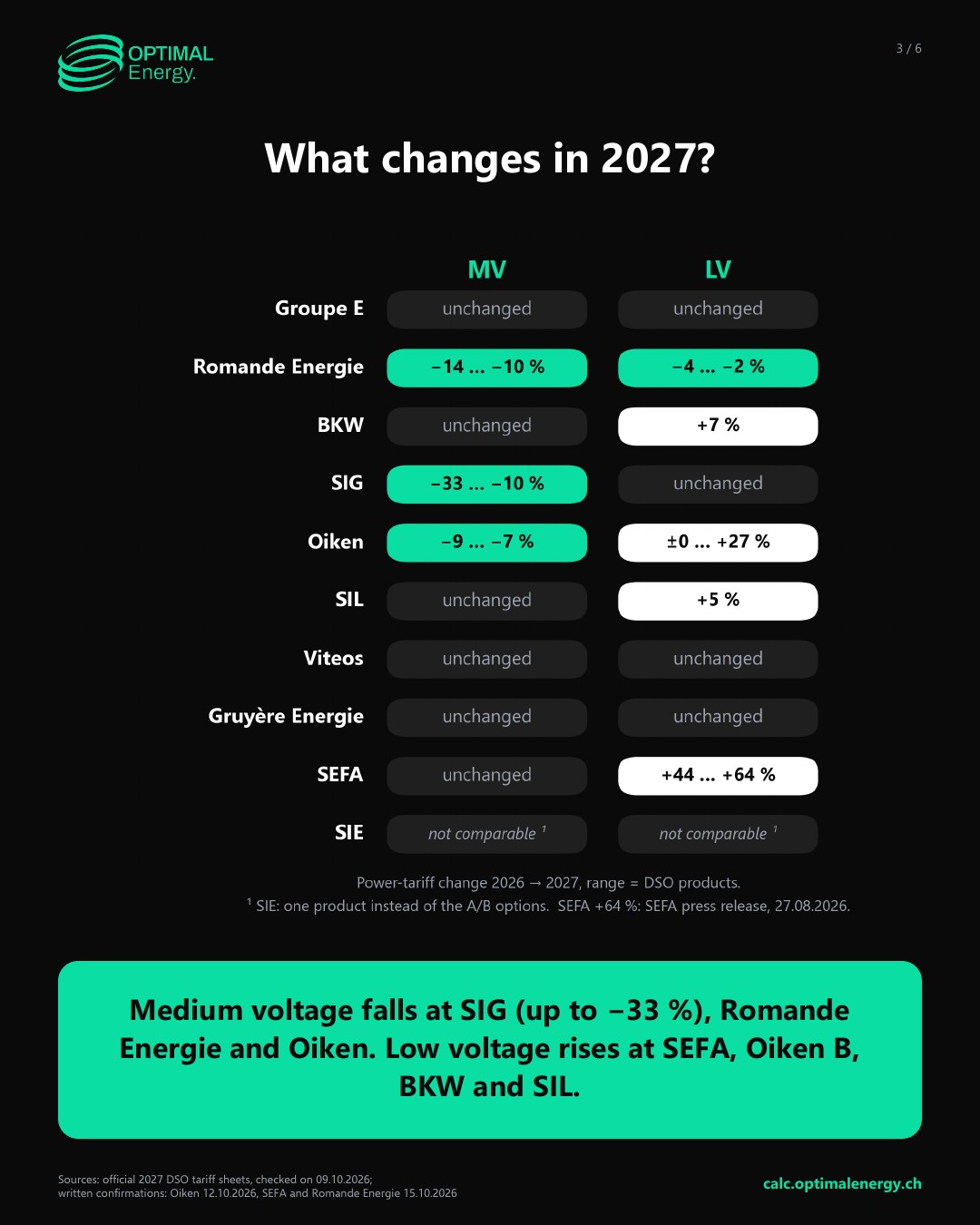
At medium voltage (MV), one kW of peak gets cheaper at SIG (up to −33 %), Romande Energie and Oiken.
At low voltage (LV), it gets dearer at SEFA (+44 to +64 %, announced on 27.08.2026), Oiken, BKW and SIL.
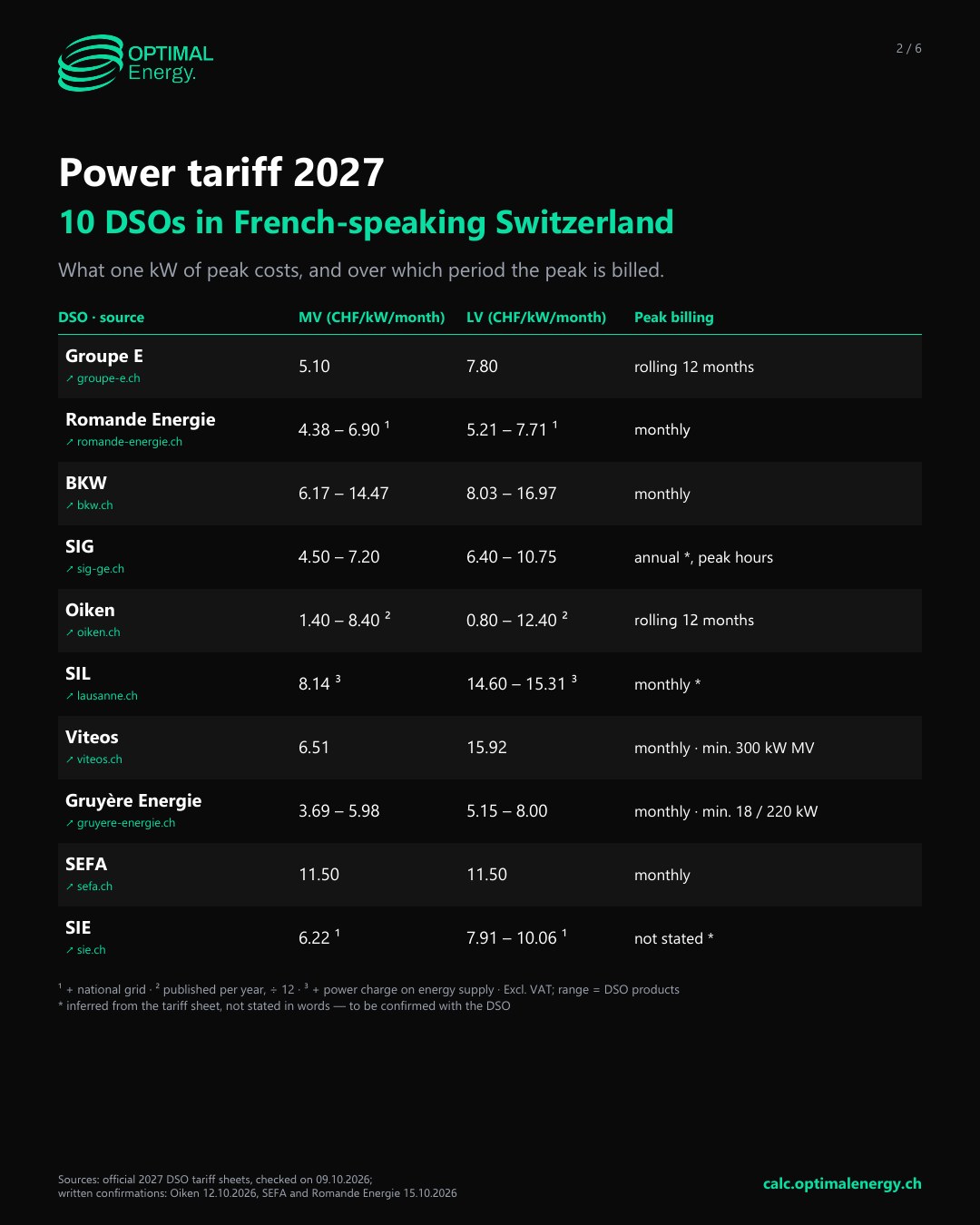
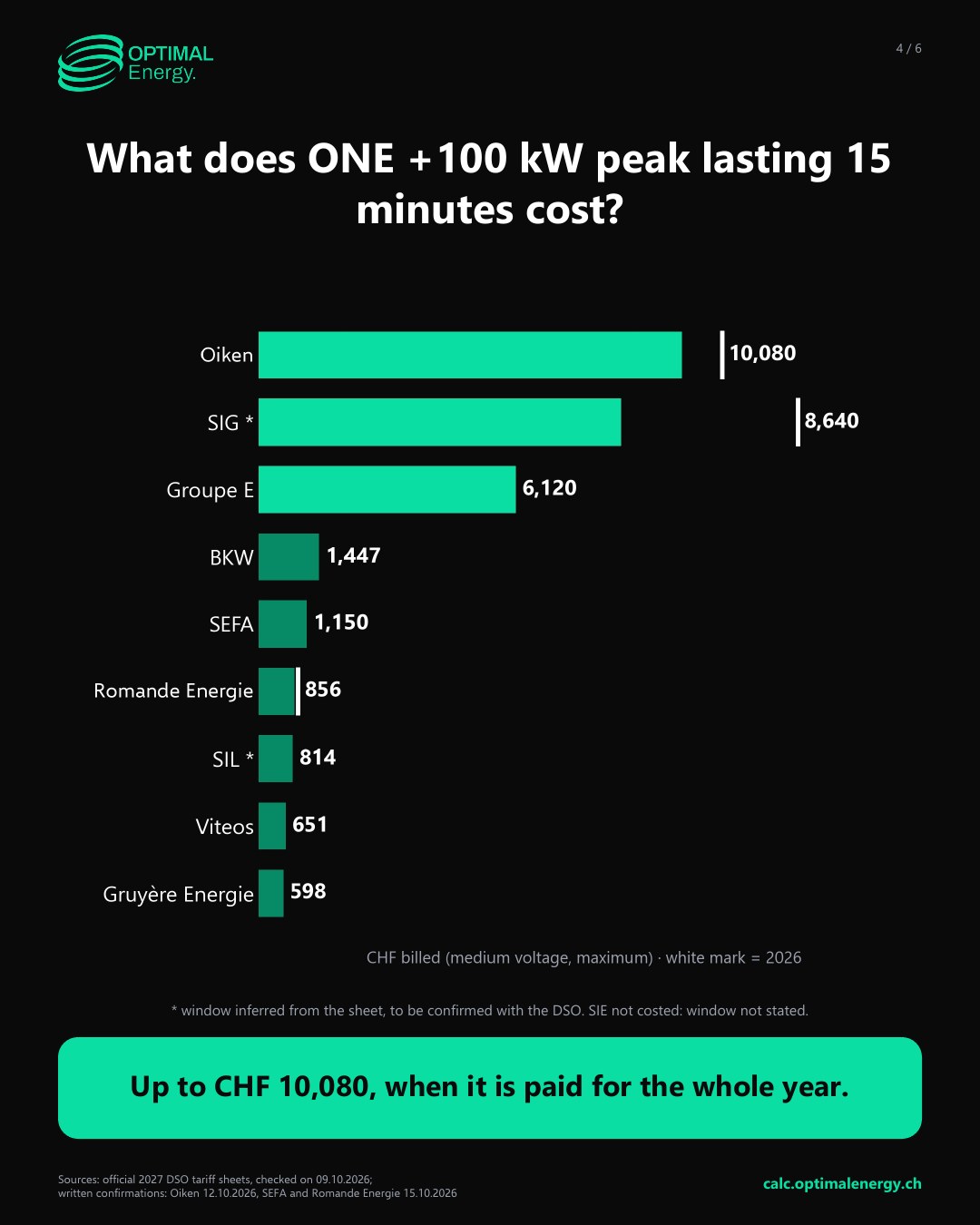
The 2027 ranges are wide: CHF 1.40 to 14.47/kW/month at MV and CHF 0.80 to 16.97/kW/month at LV.
Structures change too: SIE and SEFA (LV) move to a single product, Gruyère Energie and SEFA change their peak hours, and SEFA drops the quarterly peak-billing option in 2027 (confirmed in writing on 15.10.2026).
A tariff never stands alone
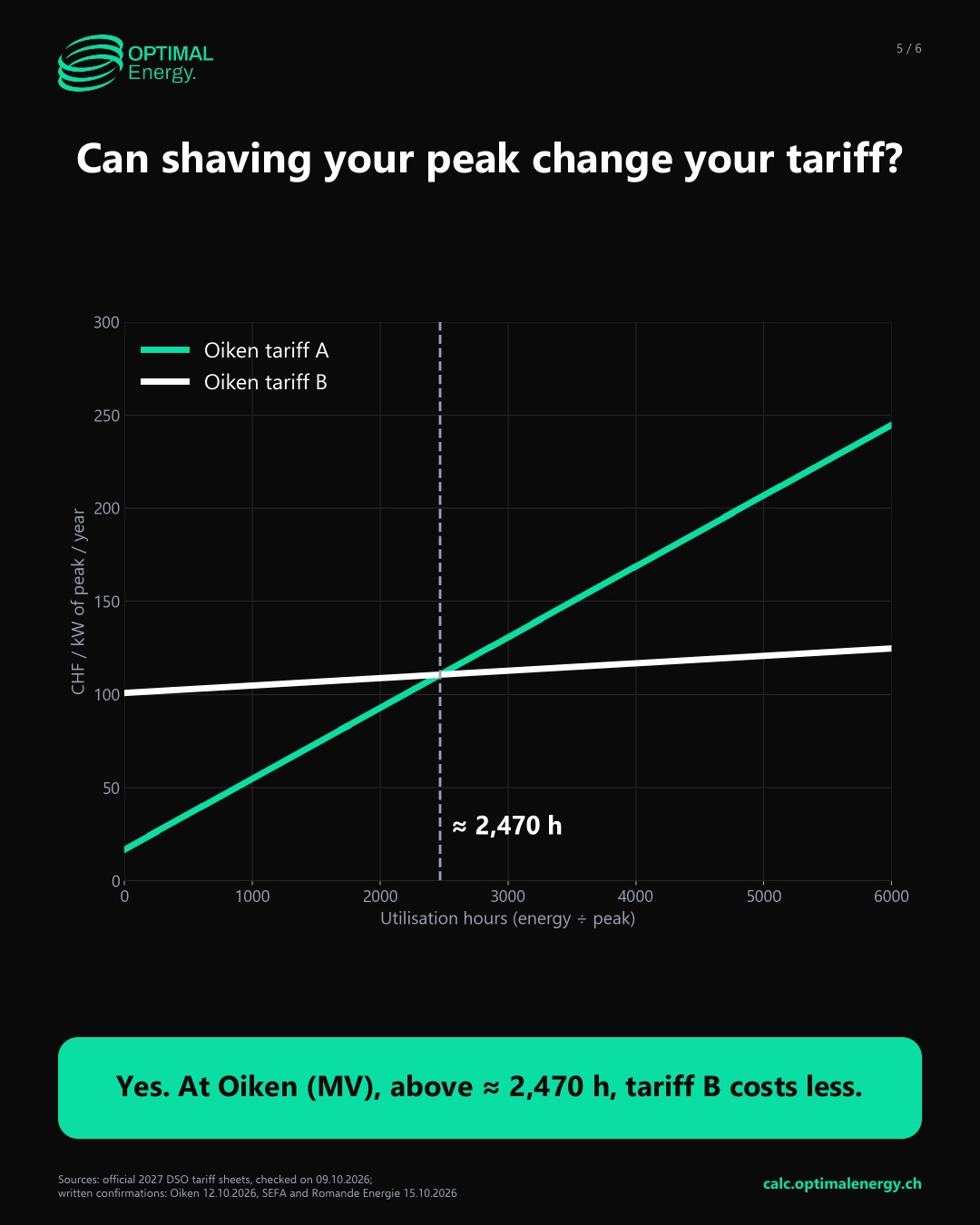
The DSO with the cheapest power is not necessarily the cheapest overall. In our comparison, the cheapest power often comes with the most expensive network energy component. Two further parameters weigh as much as the price: the billing window (1 month at some DSOs, a rolling 12 months at others) and the choice of product (at Oiken MV, tariff B becomes cheaper than tariff A above about 2,470 utilisation hours, and a battery that lowers the peak raises those hours).
What it means for a battery
The value of peak shaving differs from one DSO to another and from one year to the next. Sizing must start from the site’s real tariff, billing window and load curves, not from a national average.
The 2022 to 2027 tariffs of these DSOs are built into calc.optimalenergy.ch, which sizes a battery on a site’s 15-minute load curves and its DSO’s real tariff, then computes NPV, IRR and payback.
Sources: official 2027 tariff sheets of the ten DSOs (checked 09.10.2026); SEFA press release, 27.08.2026; written confirmation from SEFA, 15.10.2026. Comparisons: network power component, excl. VAT.

