

Official 2027 tariff sheets: Groupe E · Romande Energie · BKW · SIG · Oiken · SIL · Viteos · Gruyère Energie · SEFA · SIE
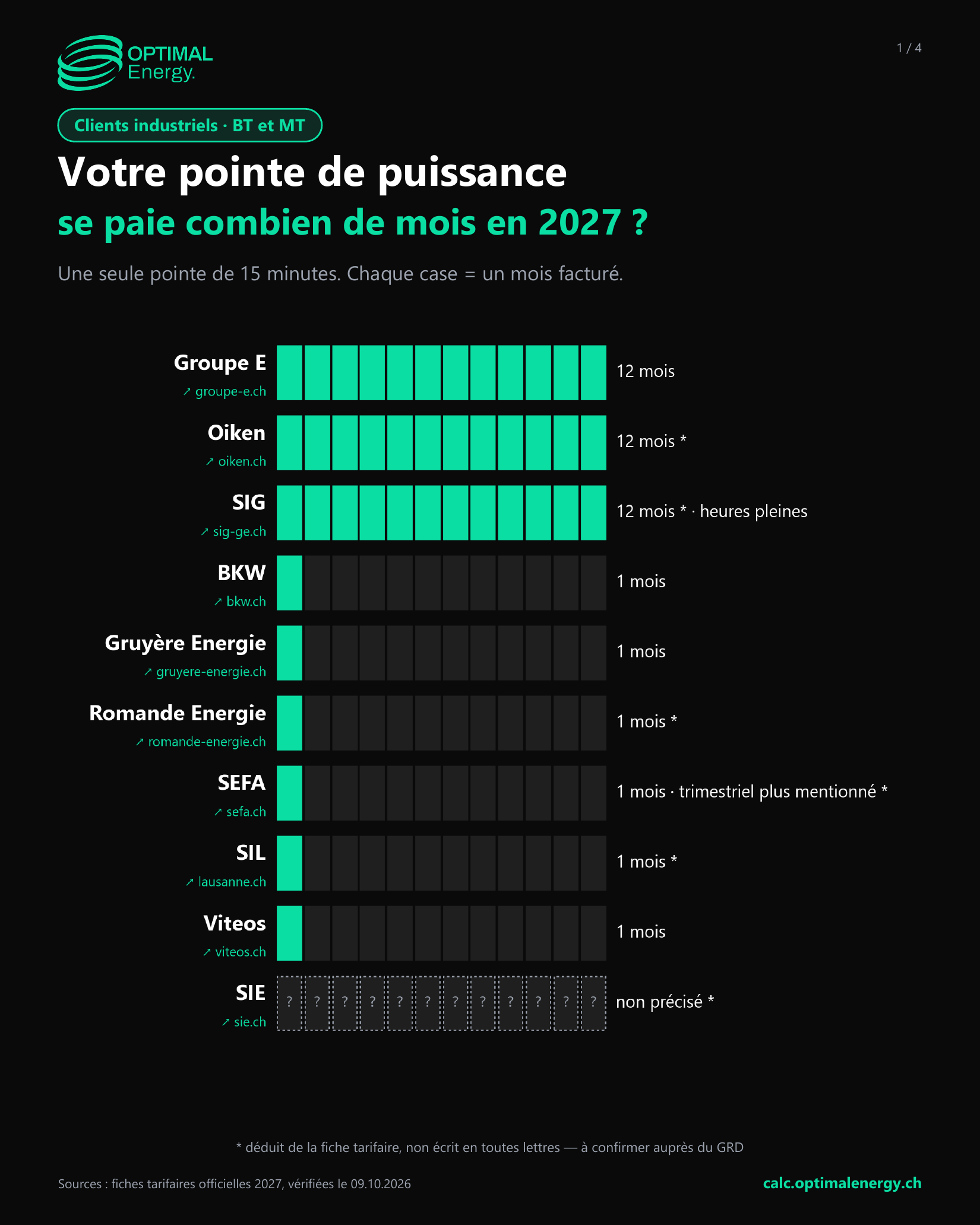
For an industrial site or a large consumer (not a household), the network bill includes a “power” component: you pay for every kW of your highest 15-minute peak. What is often overlooked is for how many months that peak is billed. In 2027 the answer ranges from 1 to 12 months depending on the distribution system operator (DSO). For anyone installing a battery to shave peaks, this matters as much as the price per kW.
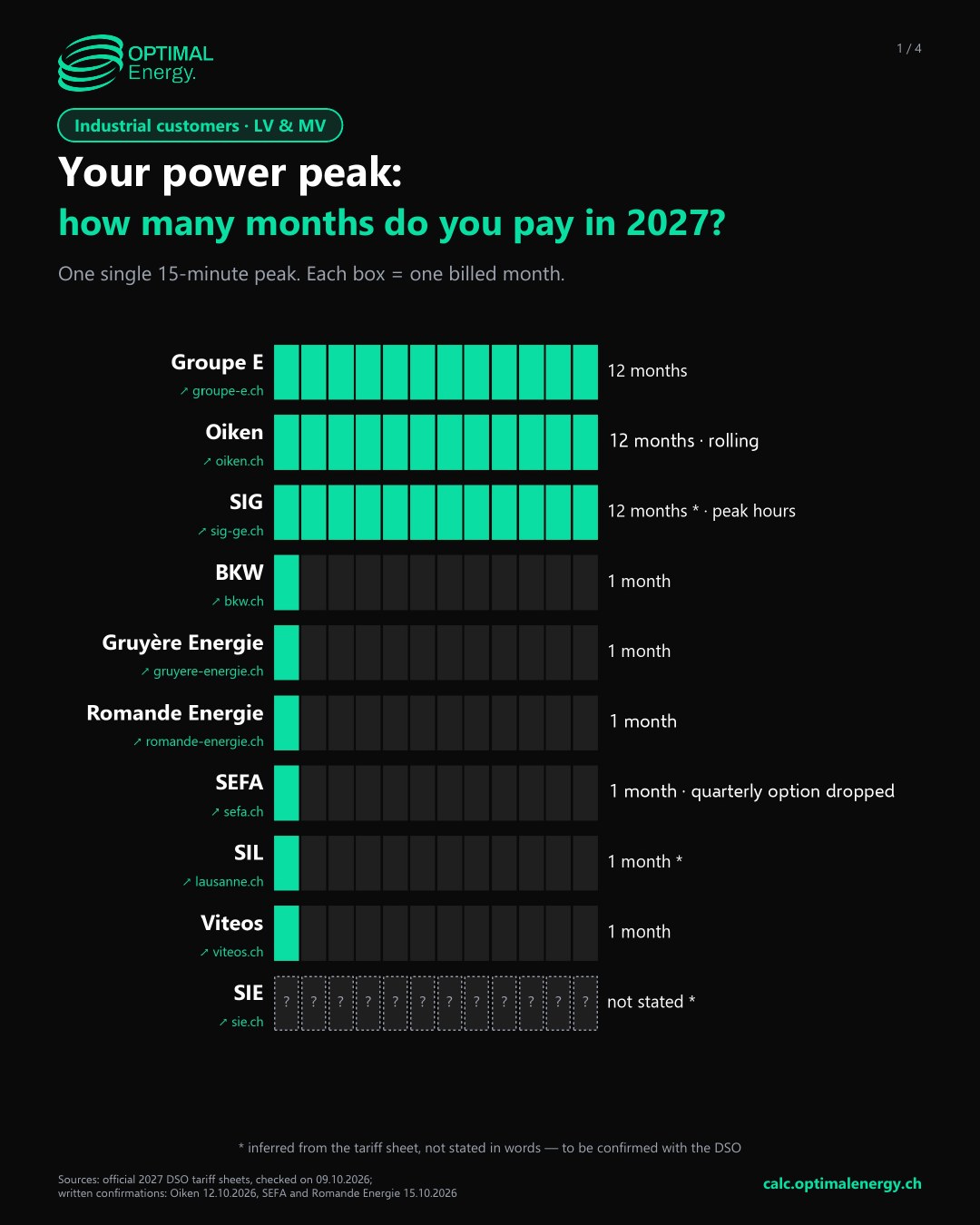
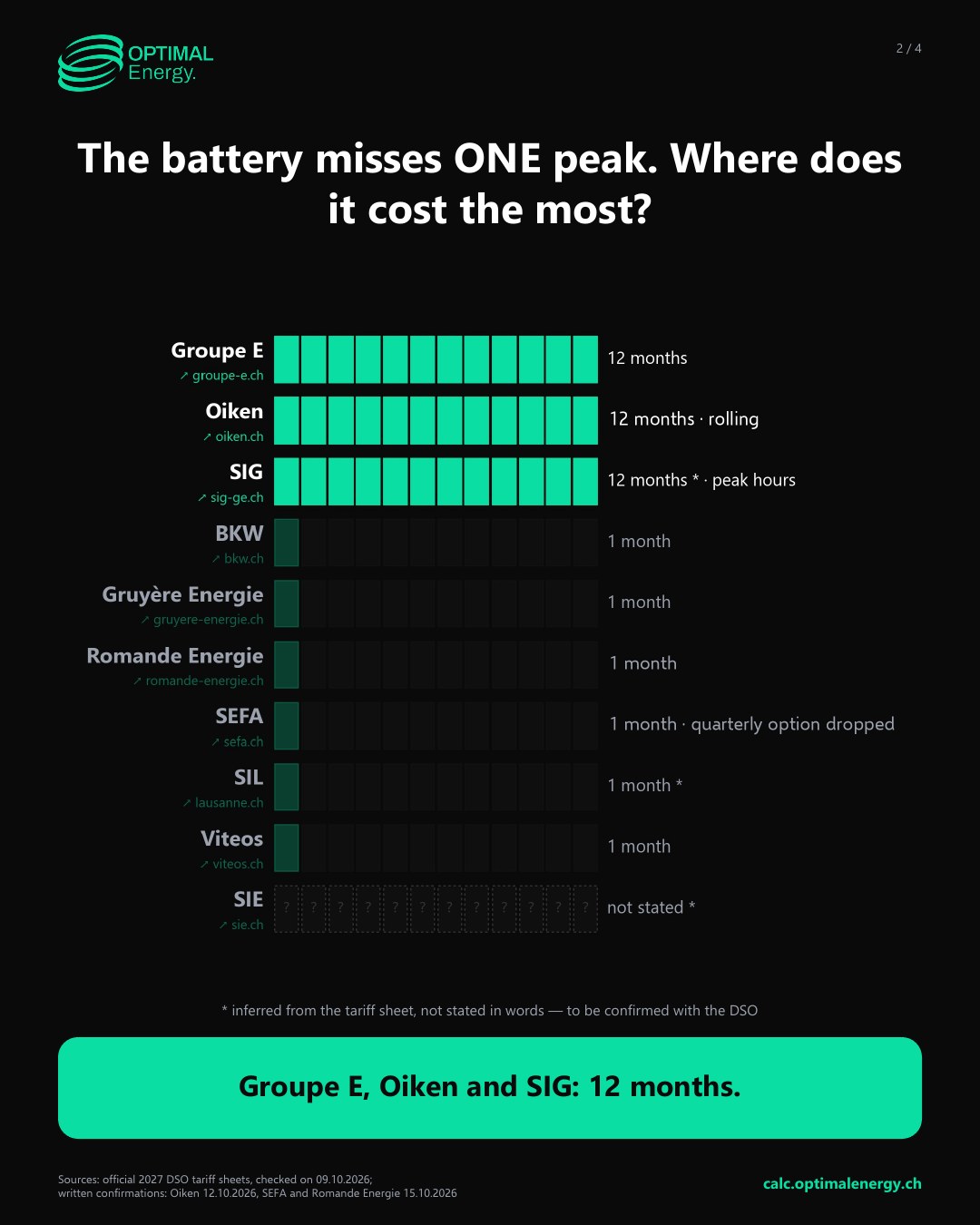
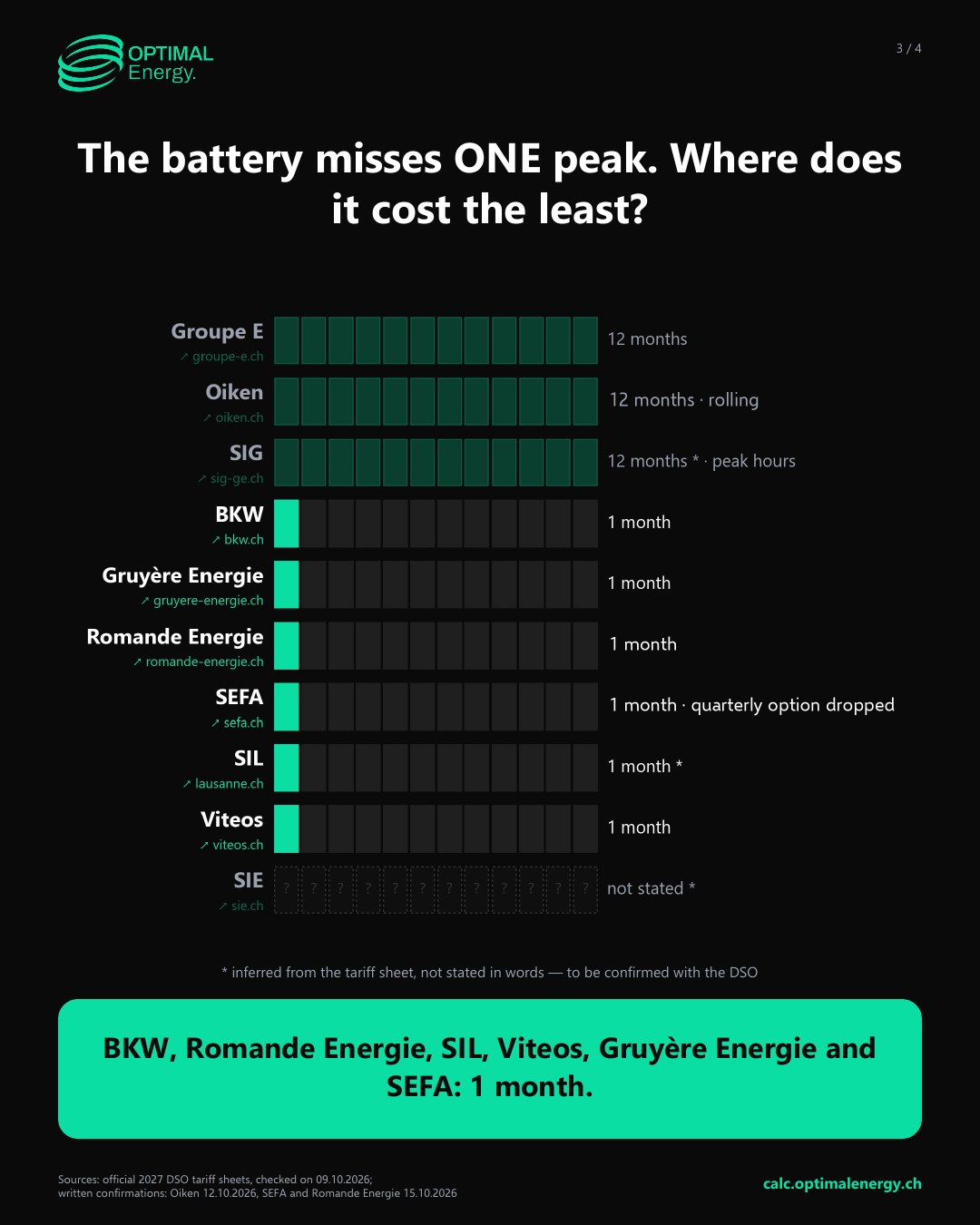
The scenario: the battery misses one peak
Suppose that one day the battery is empty or unavailable at the wrong moment, and the site’s peak rises by 100 kW for 15 minutes. For how many months will that peak be billed?
| DSO | 2027 billing window | Status |
|---|---|---|
| Groupe E | rolling 12 months | tariff sheet |
| Oiken | rolling 12 months | confirmed in writing, 12.10.2026 |
| SIG | annual maximum, peak hours only | inferred from the sheet* |
| BKW | 1 month | tariff sheet |
| Romande Energie | 1 month (PRO tariffs), all hours, in kW | confirmed in writing, 15.10.2026 |
| SIL | 1 month | inferred from tariff conditions* |
| Viteos | 1 month | tariff sheet |
| Gruyère Energie | 1 month | tariff sheet |
| SEFA | 1 month, quarterly option ends | confirmed in writing, 15.10.2026 |
| SIE | not specified on the 2027 sheet | to be confirmed* |
* inferred from the tariff sheet, not stated in words: to be confirmed with the DSO.
What a missed peak costs
Based on the network power component at medium voltage, excluding VAT, for each DSO’s most expensive product, one missed +100 kW peak lasting 15 minutes costs in 2027:
- with a monthly window: CHF 369 to 1,447;
- with an annual window: up to CHF 6,120 at Groupe E, 8,640 at SIG and 10,080 at Oiken.
In 2026 the maximum was CHF 12,840. SIG cuts its medium-voltage power price by 10 to 33 % in 2027, so the most expensive missed peak is now at Oiken.
A double-edged window
Over 12 months, a single missed quarter-hour can wipe out a whole year’s savings. The battery must be sized, and operated, for the worst day: enough energy in reserve, a reliable load forecast, a safety margin.
Over 1 month, a mistake costs only one month. In return, the battery has to succeed twelve times a year: every month resets the counter.
Two more rules change the maths: the minimum billed power (below a threshold, for example 300 kW at Viteos at medium voltage, shaving earns nothing), and the hours that count (at SIG only peak-hour maxima appear to count).
Before you invest
- Check your DSO’s exact rule for your product (LV or MV). Several DSOs do not state it explicitly; we had to ask them.
- Simulate the battery on your own 15-minute load curves, with the right billing window, and look at the worst day, not just the average.
- Compare several sizes.
On calc.optimalenergy.ch, the billing window is a study parameter, alongside the real 2022–2027 tariffs of French-speaking Swiss DSOs. The tool searches for the optimal size and computes NPV, IRR and payback.
Sources: official 2027 tariff sheets of Groupe E, Romande Energie, BKW, SIG, Oiken, SIL, Viteos, Gruyère Energie, SEFA and SIE (checked 09.10.2026); written confirmations from Oiken (12.10.2026), SEFA and Romande Energie (15.10.2026); SEFA press release of 27.08.2026.

