

Switzerland currently has around 0.6 GWh of stationary battery storage capacity. Long-term energy scenarios indicate this could grow to around 9 GWh by 2050, driven mainly by solar PV and wind expansion. This remains small compared with the possible scale of solar deployment: Switzerland could reach around 40 GW of PV capacity by 2050. That gap matters. Solar creates large volumes of variable production; batteries help manage the short-term mismatch between when electricity is produced and when it is valuable.
The first wave of battery projects in Switzerland and Europe was largely driven by ancillary services. These markets rewarded assets that could react quickly to help stabilize the grid. In Switzerland, secondary reserve revenues reached very high levels during the energy crisis, with annual SRL revenues peaking around 747 kCHF/MW/year, compared with much lower levels before and after the crisis.
But this is also the warning for investors: relying on one market is risky. The Swiss ancillary service market is limited in size, with roughly 65 MW for primary reserves and 400 MW for secondary reserves, while Switzerland already has more than 5.7 GW of flexible hydro capacity in its ten largest storage and pumped-storage plants. As more batteries enter the same market, revenues can be diluted.
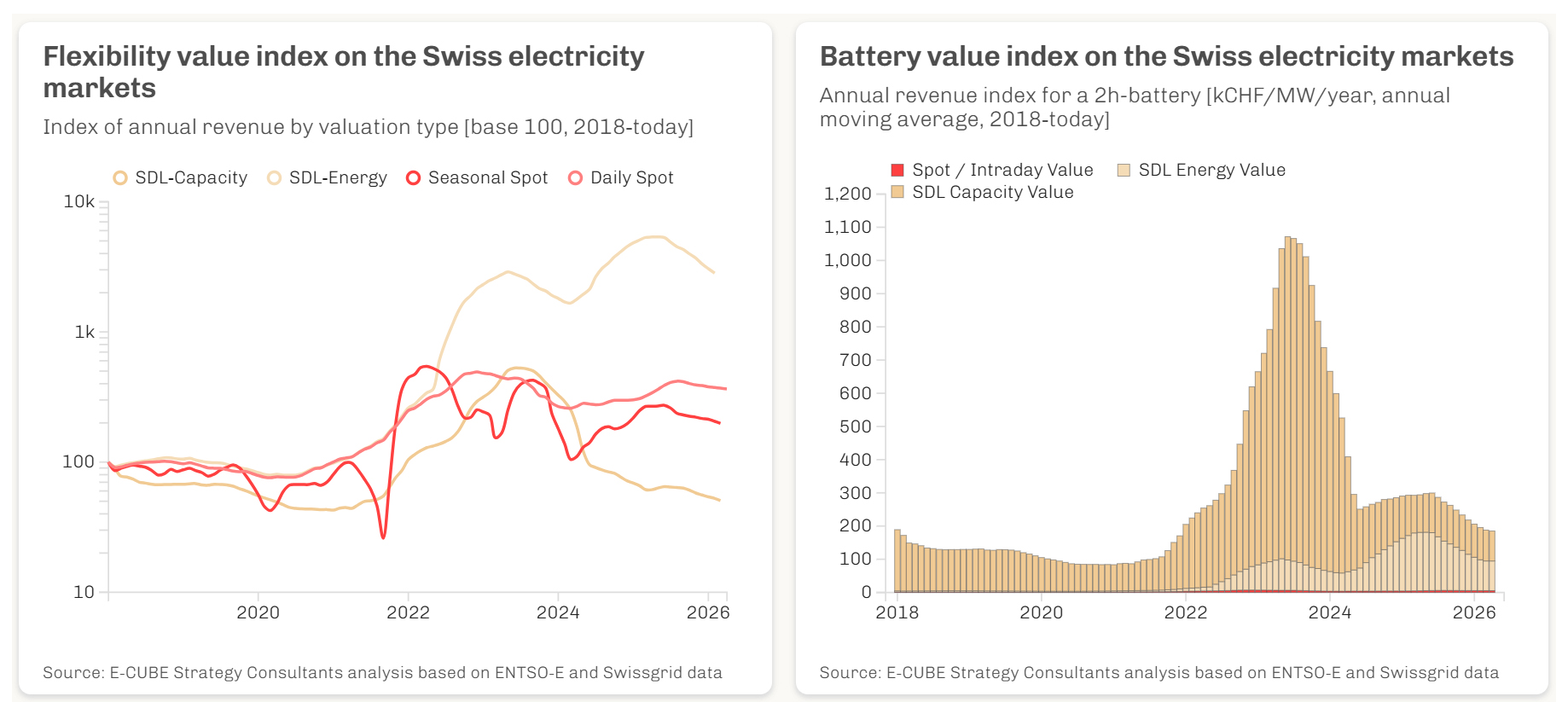
Reference: Strategic Dashboard of the Swiss Energy Market by E-Cube
The next investment logic is therefore not “battery equals ancillary services.” It is “battery equals flexible financial asset.”
Short-term electricity markets are becoming more relevant. Since 2021, Switzerland and Germany have seen several hundred daily price spreads above €100/MWh. These spreads create opportunities for batteries to charge during low-price hours and discharge during high-price hours. The more solar enters the system, the more likely midday prices fall and morning/evening spreads become relevant.
However, the economics are not automatic. Large-scale battery investment costs in Europe and Switzerland are estimated around 300–700 k€/MWh, depending on size, grid connection, land, and project design. The levelized cost of storage for projects above 1 MWh is estimated around €140–390/MWh. In specific optimized cases, Swiss projects could potentially reach below CHF 150/MWh, but only when site, grid access, battery procurement, and operating strategy are all favorable.
This is the key financial point: the battery hardware is only part of the investment case. Grid connection, land, and peak power charges can represent a large part of total annual costs — potentially up to 50% in some cases. A battery located on an existing industrial or energy site with available grid infrastructure can have a materially better business case than the same battery built on a new, unequipped site.
For investors, this means site selection is not a technical detail. It is a core financial variable.
The strongest business models will likely combine several revenue streams: ancillary services, market arbitrage, balance group optimization, self-consumption, peak shaving, and risk hedging. A battery used for only one purpose is more exposed to market saturation. A battery integrated into a broader portfolio has more ways to create value and reduce volatility.
There is also an “option value” that is often underestimated. Batteries can reduce exposure to extreme prices, imbalance costs, and forecast errors. This is particularly relevant for suppliers, producers, industrial consumers, and balance groups exposed to volatile solar generation. In a system with around 30 TWh/year of PV generation, the share of supply volume that still needs active short-term management could rise from 12% to 43%, increasing the value of flexible tools that can respond quickly.
The conclusion is balanced: batteries are not a guaranteed return product. They are also not just a commodity container. Their financial value depends on the use case, location, market access, operating model, and optimization capability.
For Switzerland, the most attractive battery projects will likely be those that combine:
- good grid connection conditions;
- access to multiple revenue streams;
- integration with PV, industrial load, or a balance group;
- active optimization instead of static operation;
- a clear strategy for managing market risk.
This supports the emergence of business models such as battery operation services, portfolio-based optimization, and Battery-as-a-Service. These models do not depend only on owning batteries. They focus on making battery flexibility usable, tradable, and financially relevant for energy companies, industrial clients, and asset owners.
The battery opportunity in Switzerland is real, but selective. The winners will not necessarily be the largest projects. They will be the best-positioned and best-operated projects.

