

Europe’s battery storage market entered a new phase in 2025. The message from the EU Battery Storage Market Review 2025 is simple: batteries are no longer only a residential solar add-on. They are becoming strategic infrastructure for electricity systems, investors, and companies exposed to power price volatility.

In 2025, the EU installed 27.1 GWh of new battery storage capacity, a 45% year-on-year growth. This was the 12th consecutive record year for EU battery deployment. Total installed battery capacity in the EU reached 77.3 GWh by the end of 2025.
The most important change is not only the growth rate. It is the market structure. For the first time, utility-scale batteries became the main growth driver, delivering 55% of new installed capacity in 2025. Residential batteries declined for the second consecutive year, while commercial and industrial batteries grew but remained a small share of the market.

Europe’s battery storage market entered a new phase in 2025. The message from the EU Battery Storage Market Review 2025 is simple: batteries are no longer only a residential solar add-on. They are becoming strategic infrastructure for electricity systems, investors, and companies exposed to power price volatility.
In 2025, the EU installed 27.1 GWh of new battery storage capacity, a 45% year-on-year growth. This was the 12th consecutive record year for EU battery deployment. Total installed battery capacity in the EU reached 77.3 GWh by the end of 2025.
The most important change is not only the growth rate. It is the market structure. For the first time, utility-scale batteries became the main growth driver, delivering 55% of new installed capacity in 2025. Residential batteries declined for the second consecutive year, while commercial and industrial batteries grew but remained a small share of the market.
Why This Matters for Investors
Battery storage is becoming valuable because the electricity system is becoming harder to manage.
Solar and wind are expanding, but grids and flexibility are not growing at the same speed. The report highlights that solar PV growth in the EU slowed in 2025, with annual installations falling slightly to 65.1 GW, the first decline in a decade. One reason is not lack of demand for clean energy, but weak system integration: grid constraints, missing flexibility, and lower solar capture rates.

This creates the core investment logic for batteries:
- more renewable energy creates more volatility;
- more volatility creates more need for flexibility;
- flexibility creates new revenue opportunities;
- batteries are one of the fastest assets to deploy for that flexibility.
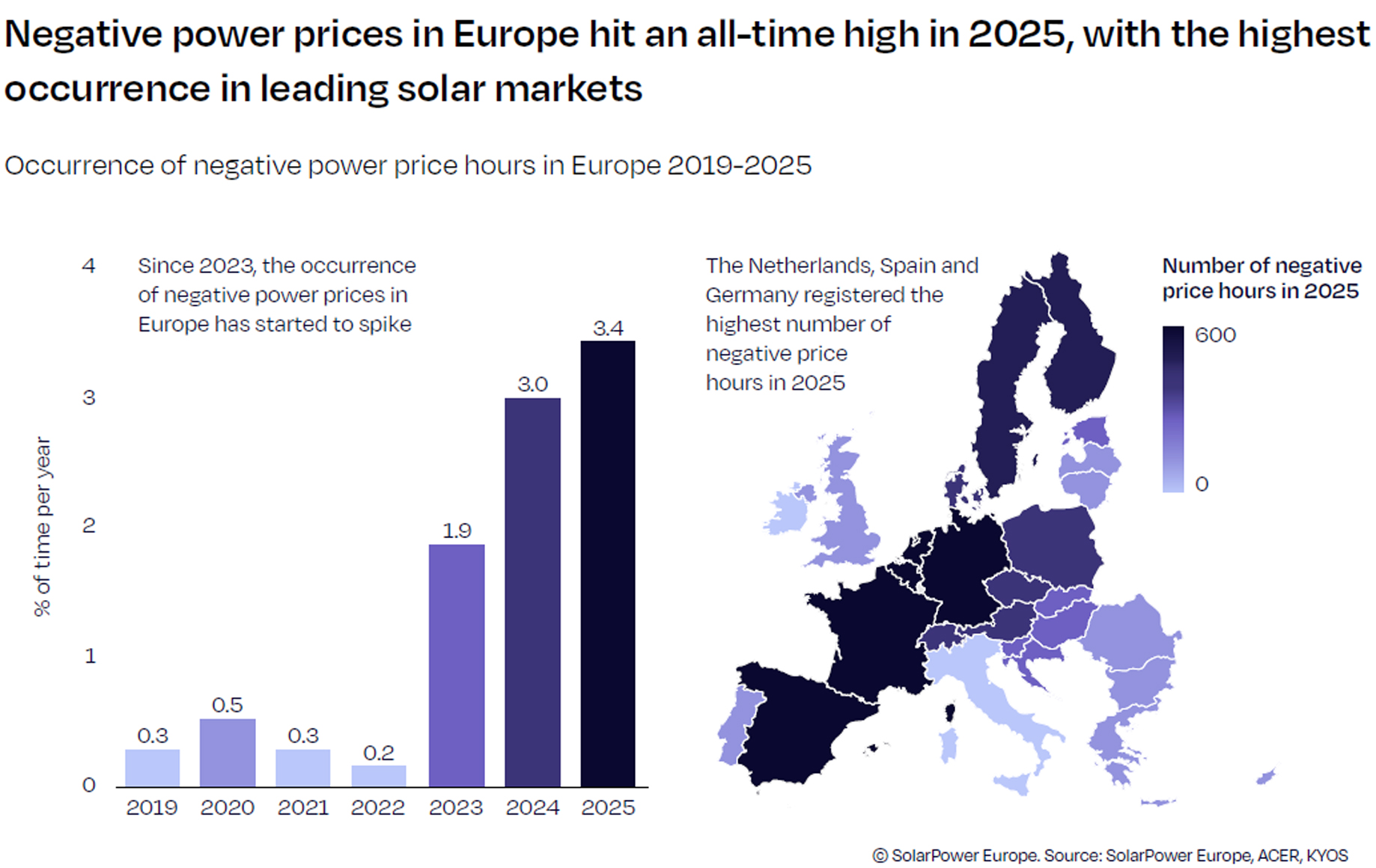
The report also shows that negative power prices reached a new high in Europe in 2025, occurring 3.4% of the time, equal to around 310 hours.
The Business Model Is Moving Toward Revenue Stacking
The report is clear that batteries need access to several revenue sources. Storage should be able to participate in wholesale trading, balancing services, capacity mechanisms, and grid stability services such as inertia and black start. This is important because relying on one revenue stream increases risk.
This supports a strong role for software platforms, aggregators, and Battery-as-a-Service models. The battery itself is only one part of the value chain. The commercial value comes from deciding when to charge, when to discharge, which market to serve, and how to manage risk.
In simple terms: the winner is not only the company that owns batteries. The winner is the company that can operate them intelligently.

Costs Are Moving in the Right Direction
The report expects utility-scale storage expansion to accelerate in Europe in 2026, supported by falling system costs, policy changes, and growing flexibility needs. Rystad Energy’s section states that European utility-scale BESS additions could reach close to 13 GW in 2026, around 50% more than 2025 additions. It also notes that turnkey system costs are moving close to 200 EUR/kWh, improving the economics of standalone and solar-linked battery projects.
Another section reports that European BESS prices declined from 2024 through the first three quarters of 2025, driven by competition, lower upstream material prices, and price pressure from Chinese suppliers. For Q4 2025, two-hour AC-side systems delivered duty paid to Europe were estimated at 94–118 USD/kWh, around 10% lower year-on-year.


