

An industrial battery is a 15 to 20-year decision. Meanwhile, your distribution system operator’s (DSO’s) tariffs change every year, feed-in remuneration evolves, and the power market is transforming: from 3 November 2026 the Swiss spot market has 96 prices a day instead of 24. Before signing an offer, these are the questions that separate a project that pays back from one that disappoints.
1. What is my peak, and for how many months is it billed?
Peak shaving is often an industrial battery’s first source of value. It depends on the price per kW (CHF 0.80 to 16.97/kW/month depending on the DSO in 2027) and on the billing window: 1 month at some DSOs, a rolling 12 months at others. Over 12 months, one missed peak can cost the year’s savings.
2. Are my solar surpluses regular enough?
Storing midday solar for the evening only helps if surpluses occur on enough days and the site can use them later. An annual balance is not enough: look at the 15-minute curves, season by season.
3. What is an exported kWh worth, today and tomorrow?
Feed-in tariffs are falling and becoming more variable. The lower they go, the more it pays to keep your energy. A serious study tests several price paths.
4. Can the battery also sell flexibility?
A peak-shaving battery is not busy all the time. Its free hours can provide flexibility services to third parties (suppliers, balance groups), as long as this never empties the battery just before the site’s peak.
5. Will my load change?
Electric vehicles, heat pumps or a new production line can make today’s sizing too small in three years, or too large if a process disappears.
6. Which size?
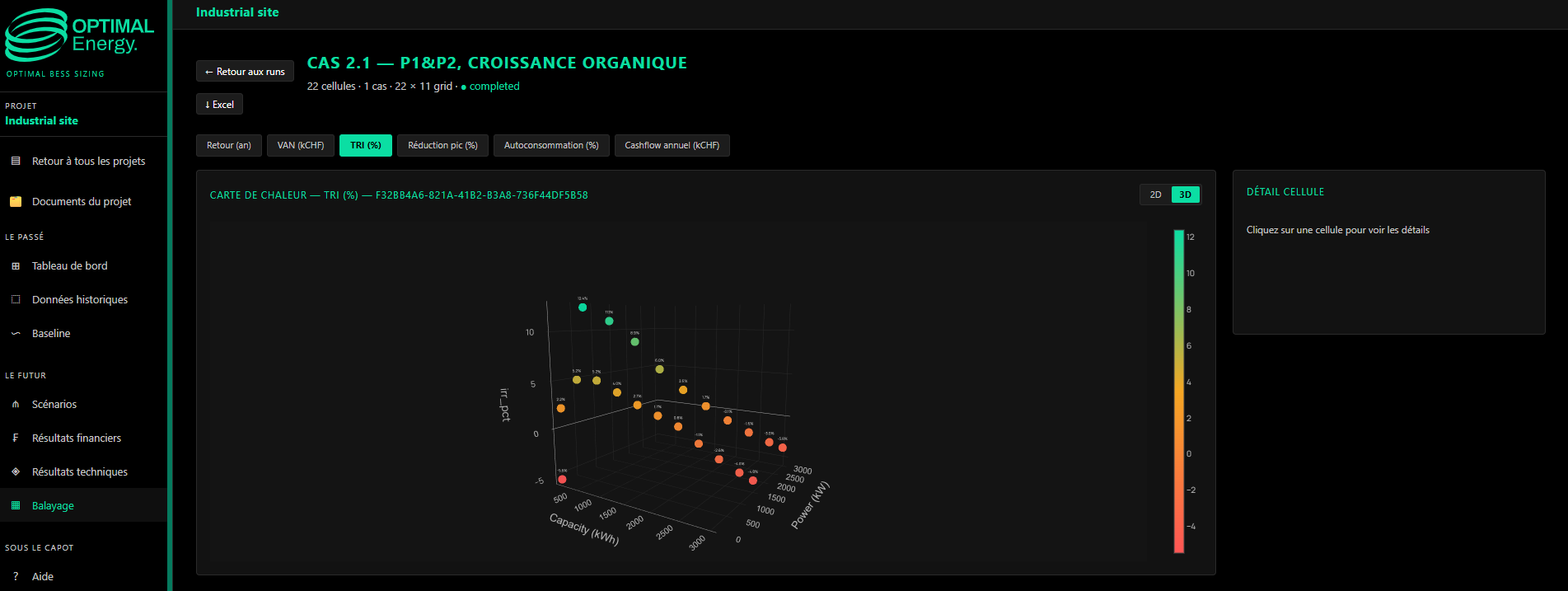
Too small, the battery misses peaks. Too large, it costs more than it earns. The right size comes from systematically comparing combinations of power (kW) and capacity (kWh).
7. Which NPV, IRR and payback, across scenarios?
One profitability figure is not enough. See how it reacts to tariff changes, load changes and faster ageing. A payback close to the warranty period is a warning sign.
8. Where will the battery go?
The location must meet AEAI fire-protection requirements, be accessible for maintenance and close to the grid connection. Settle it early.
What calc.optimalenergy.ch does
calc.optimalenergy.ch (Optimal BESS Sizer) answers questions 1 to 7 on real data: your 15-minute load and production curves; the real 2022–2027 tariffs of 10 French-speaking Swiss DSOs with their billing windows; self-consumption, peak shaving and third-party flexibility in a single 20-year optimisation; a declining feed-in tariff and grid accounting per the VSE/AES storage handbook (MDSE); a size sweep to find the optimal capacity, then NPV, IRR and payback with a client-ready report. Question 8 remains on-site engineering work.
If a battery offer does not address these questions, ask why.

