

Flexibility platform · Battery-as-a-Service
Reserve a virtual battery. Use it your way.
A neutral and independent platform: battery owners share their asset, and companies get a dedicated virtual battery to use however they want — energy arbitrage, a buffer to cut imbalance penalties, importing and storing energy from neighbouring countries, or offering on the ancillary-services market. We are a local marketplace, able to perform capacity allocation and pricing for certain products.
Virtual batteries
Optimised allocation
Swiss flexibility markets
What is the flexibility platform?
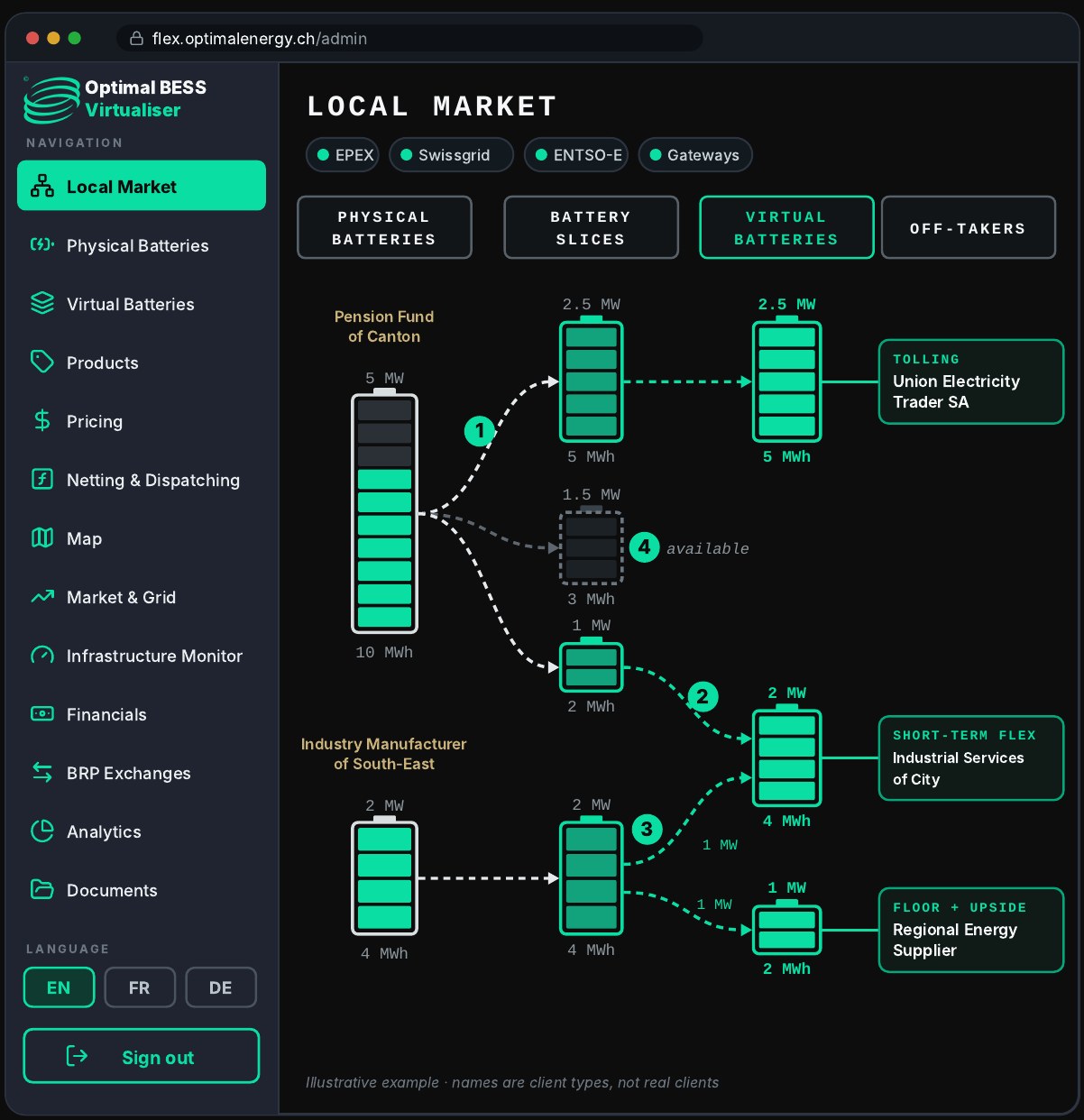
The platform mathematically slices physical batteries owned by multiple owners and assigns those slices to off-takers (energy consumers or traders) as virtual batteries.
A virtual battery is not a device — it is a powerful layer for reservation, dispatching and off-setting of a defined power (MW) and energy capacity (MWh), carved out of one or more real batteries by optimisation. The off-taker interacts with a single, well-defined resource; the owner sees their asset reserved, partly or fully, by one or more off-takers at once.
Key concepts
Physical battery
A real storage system (BESS) owned by a battery owner, described by its capacity (MWh), power (MW), efficiency and usable capacity.
Virtual battery
A contractual allocation of power and capacity, carved out of one or more physical batteries and sold to an off-taker.
Battery owner
The owner of the physical battery; typically the owner of an industrial site or a large plot of land near a medium-voltage substation. They monitor the utilisation and reservation status of their asset.
Off-taker
The energy company or energy trader who reserves a virtual battery and defines its power, capacity, duration and desired contract type. The platform finds the best combination of batteries at the best price.
How it works — capacity optimisation
At the core of the platform, an optimisation engine (mixed-integer linear programming) computes the most compact allocation that satisfies every virtual-battery request simultaneously.
- Each off-taker request (power and energy) is met by slices of one or more physical batteries.
- The engine respects each battery's power and capacity limits and round-trip efficiency.
- It reserves as little physical capacity as possible, keeping maximum capacity free for future reservations.
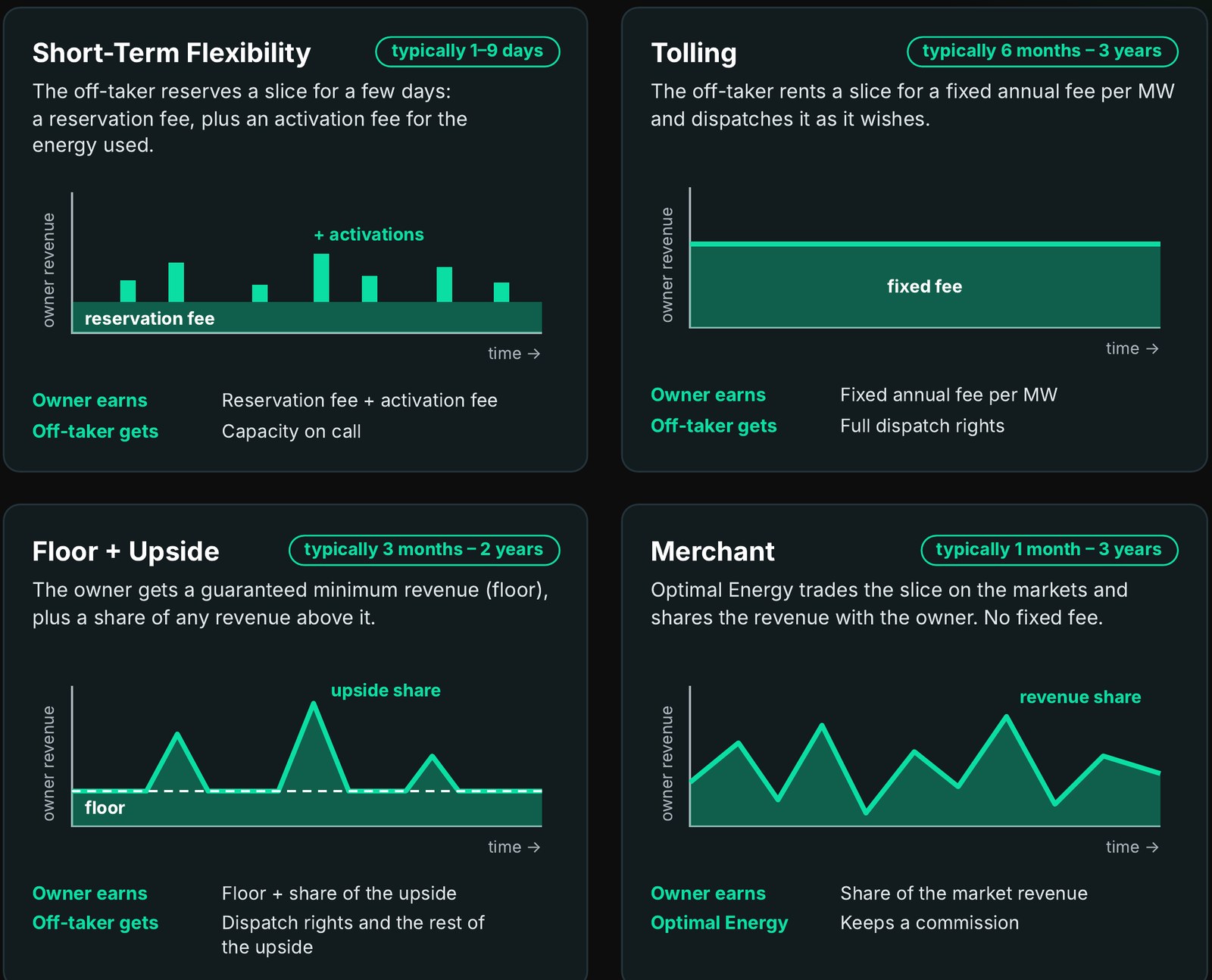
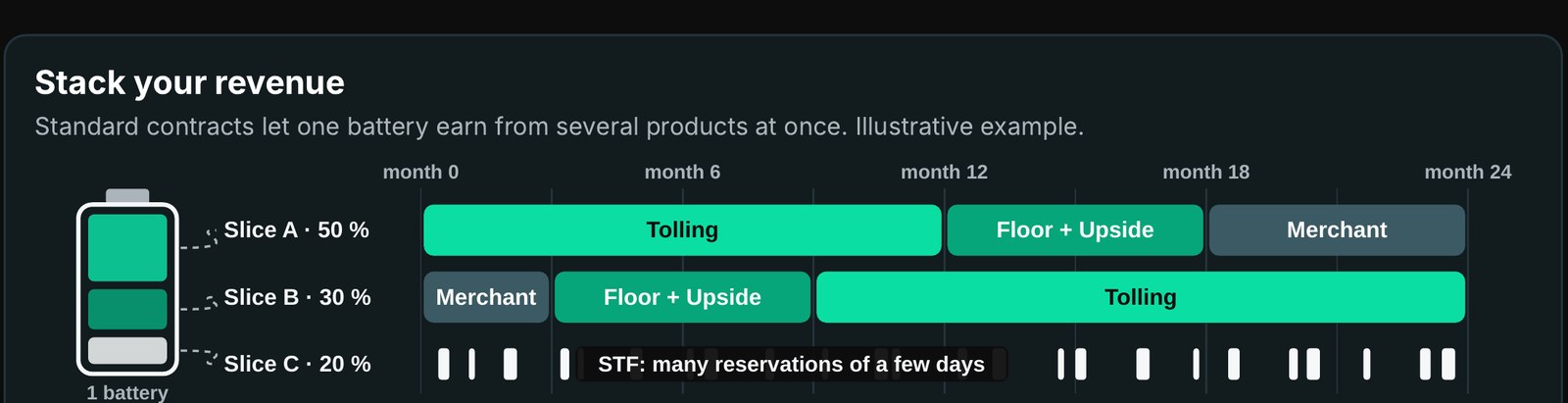
4 Products on our marketplace
BESS ownerPhysical battery
↔
Optimal Energy PlatformStandardized API & contracts
↔
Off-takers & tradersFlexibility buyers
↔
MarketsFCR · aFRR · mFRR · Spot · Intraday
Hardware · lab-tested
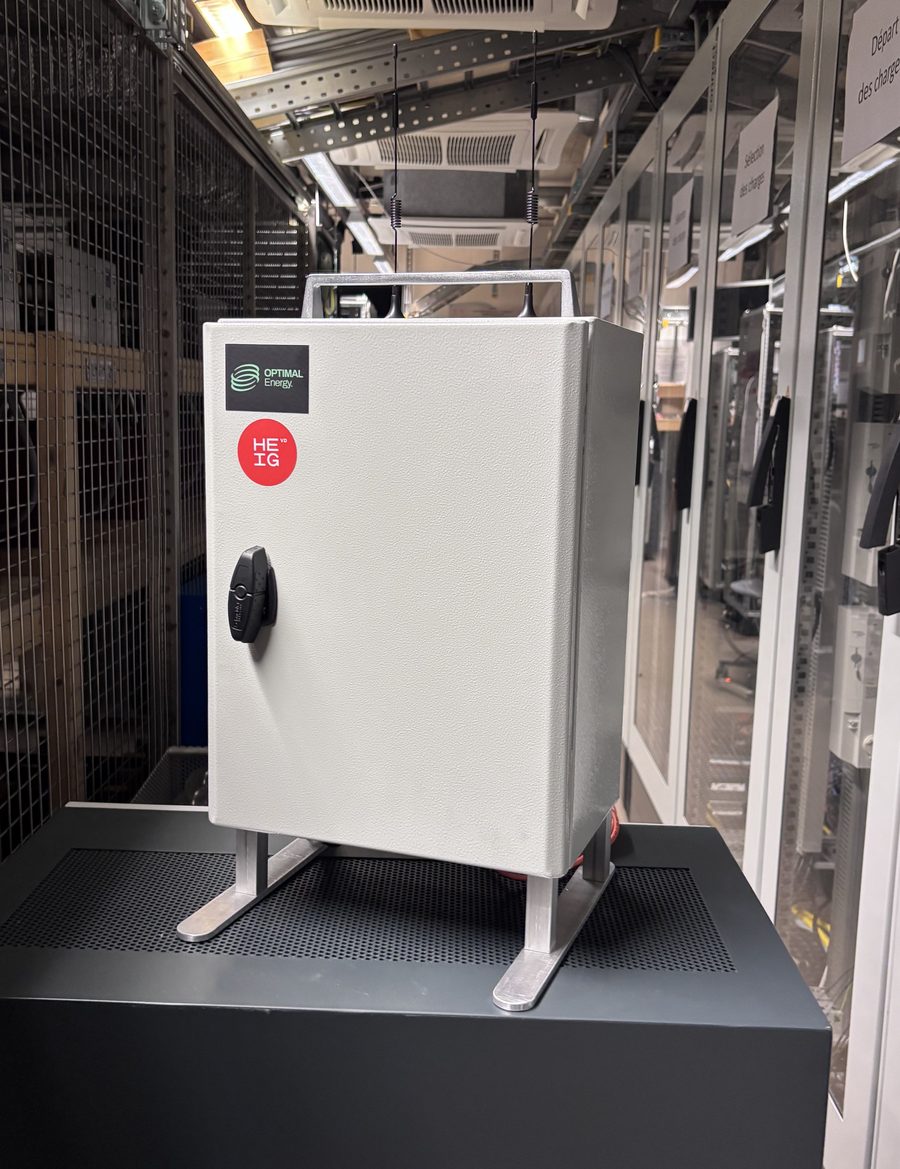
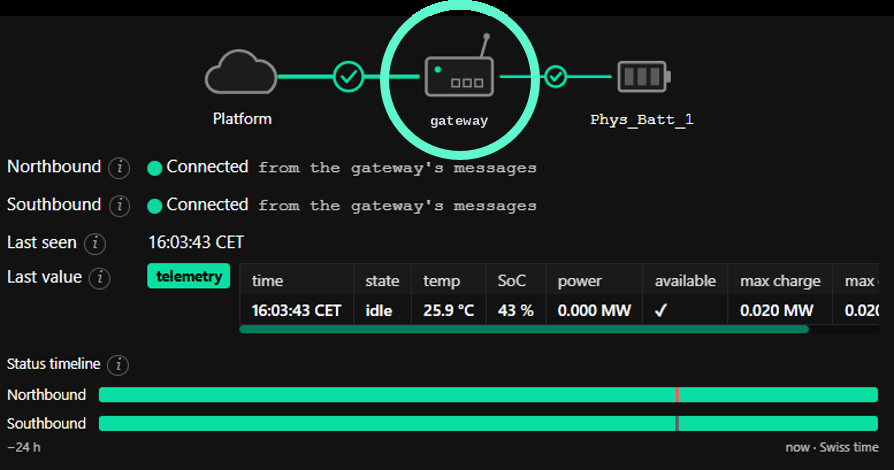
Command box: the gateway to your battery
The command box is installed next to the battery. It talks to the battery’s BMS (battery management system) over the Modbus TCP/IP protocol: it reads the battery’s state and passes on the charge and discharge commands sent by the platform.
- Read: state of charge (SoC), state of health (SoH) and other vital information (temperature, power, availability).
- Command: charge and discharge set-points.
- Monitor: the links to the platform and to the battery are watched continuously.
Tested and validated with a 20 kW / 21 kWh battery at the lab of the Energy Institute of HEIG-VD in Yverdon-les-Bains, Switzerland.
Benefits
For battery owners
Monetise your battery without operating it: one partner, multiple markets, and transparent utilisation tracking.
- No need to commit your entire capacity to a single off-taker under one long-term contract.
- Partition your battery and allocate slices to different contract types and clients.
- Maximise expected revenue and diversify risk.
- Track utilisation and reservation status with full transparency.
For off-takers & traders
Reserve flexible capacity on demand, scalable, through a standardized API — interoperable, market-ready virtual batteries.
- No CAPEX: access capacity without investing in a physical asset.
- No operational hassle: no operation, no maintenance.
- Dynamically define the contracts that suit you (power, energy, duration).
- Flexible terms that also help attract battery owners.
Why now
The Swiss context is especially favourable:
- Since 1 January 2026, Art. 14a of the Electricity Supply Act removes grid usage costs for flexible assets.
- Switzerland's energy transition is entering its mass-adoption phase, now with 14% solar electricity according to the Swiss Federal Office of Energy (SFOE).
- Enormous pressure on the grid and the electricity market, driven by solar intermittency and the abundance of production on sunny summer days.
- Battery prices are now attractive enough to drive penetration in a market like Switzerland.
- More and more physical batteries are being installed worldwide: flexibility is becoming a commodity, with many players offering and demanding it dynamically.
Onboarding · on request
Join the platform: the onboarding forms
Before the first contract, each party fills in one form: the battery owner once per battery, the off-taker once before booking capacity. Ask for the form that fits your role and we send it to you, in French, English or German.
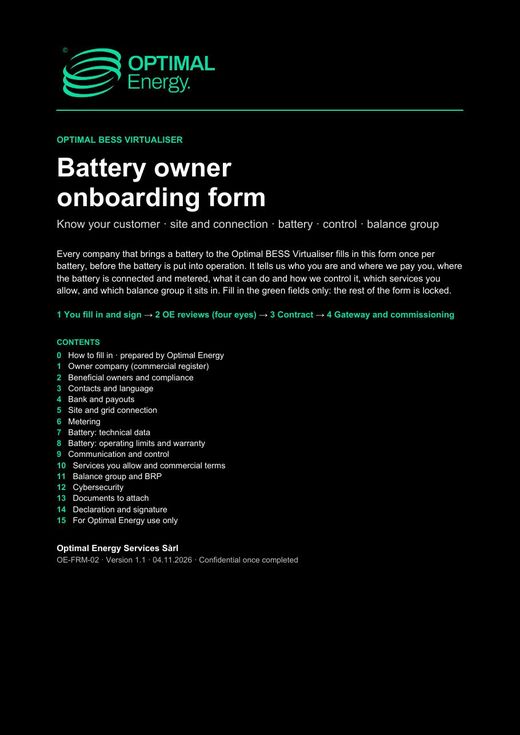
Word · PDF · FR / EN / DEBattery owner
What we need to connect your battery: company, site and grid connection, metering, technical data, control, balance group.
Would you like to download the battery owner form? Leave us your details in the contact form and we will send it to you shortly.
Yes, continue → No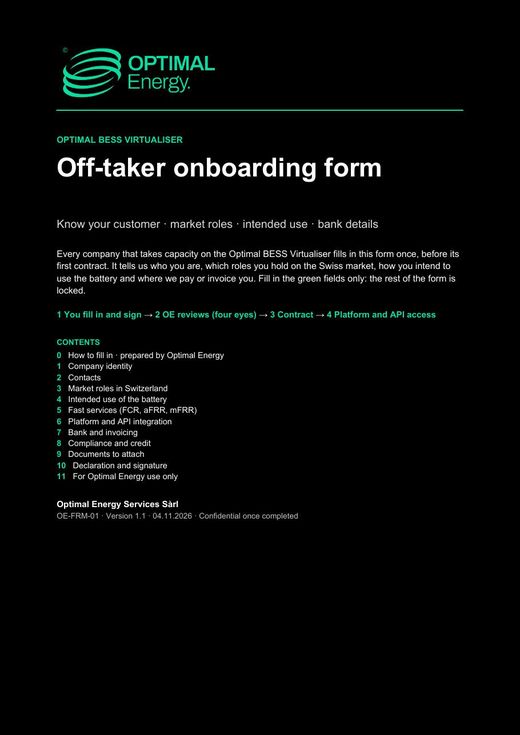
Word · PDF · FR / EN / DEOff-taker
To book capacity: company, Swiss market roles, intended use, API integration, invoicing.
Would you like to download the off-taker form? Leave us your details in the contact form and we will send it to you shortly.
Yes, continue → NoOwn a battery, or looking for flexibility?
Let's talk about how the platform can monetise your asset or secure the capacity you need.
